

Only 11-14% of enterprise AI agent pilots have reached production at scale in early 2026. The other 86-89% died somewhere between the demo and the deploy button.
That's not a vendor stat. That's Deloitte's number, and McKinsey's, and Gartner's, all roughly agreeing for once. So when your CEO sends you that LinkedIn post about agents replacing 40% of the workforce, you can show them this: most agents never make it past the pilot.
I've been digging through the actual production postmortems, framework benchmarks, and enterprise survey data from the last few months. The pattern is clearer than the headlines suggest. Agents work. But not the way Twitter says they do.
Here's what I learned about what's shipping, what's breaking, and how to tell the difference.
Show Image Hero image — illustrative concept. Production agent dashboards in 2026 emphasize observability, scoped tool access, and human escalation paths.
The 40-second answer
Agentic AI in 2026 is real, but narrow. Agents are shipping in constrained, well-bounded domains like IT ops, customer support tier-1, invoice reconciliation, and code review. Anything requiring long-horizon planning, fuzzy judgment, or high-blast-radius decisions still needs a human in the loop. The teams winning aren't the ones with the smartest models. They're the ones who built observability, scoped tool access, and rollback paths before they wrote a single agent prompt.
That's the article in one paragraph. Now let me show you the receipts.
What "agentic AI" actually means in 2026
Before the hype dictionary, agents were just LLMs with tool-calling. Now everyone's "agentic." Gartner literally coined the term "agent washing" for vendors slapping the label on chatbots and RPA scripts. Their estimate: of the thousands of vendors claiming agentic AI, only about 130 are doing anything meaningfully autonomous.
So let's pin it down. A real agent in 2026 has four properties:
- Plans: breaks a goal into steps without you spelling them out
- Acts: calls real tools, APIs, and systems (not just generating text)
- Adapts: changes the plan when a step fails or returns unexpected data
- Has memory: remembers what it did, what worked, and what to do differently
If an "AI agent" product can't do all four, it's a chatbot with extra steps.
The production gap, in actual numbers
Here's where the hype meets the spreadsheet. The data from the last six months is brutally consistent:
| Metric | Value | Source |
|---|---|---|
| Organizations with agents in production at scale | 11-14% | Deloitte, Lyzr 2026 |
| Organizations that have deployed any agent | 17% | Gartner 2026 CIO Survey |
| Orgs experimenting but not scaled | 39% | McKinsey late 2025 |
| Agentic AI projects predicted to be canceled by 2027 | 40%+ | Gartner |
| AI projects failing vs. traditional IT | 2x failure rate | RAND 2025 |
| Average agents managed per enterprise | 12 | Gartner 2026 |
| Enterprise apps expected to embed agents by end of 2026 | 40% | Gartner |
Read those numbers carefully. Adoption intent is enormous. Production reality is small. The gap between "we're trying agents" and "agents are running our business" is where most teams are stuck right now.
The interesting question isn't why so many fail. It's why the 11-14% succeed.
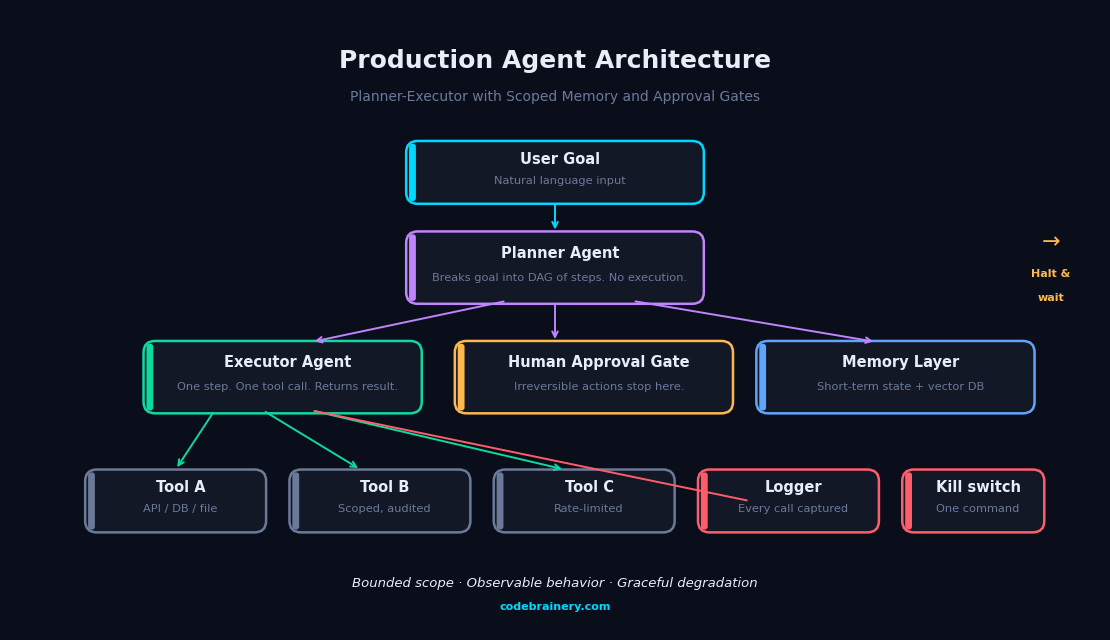
A typical 2026 production architecture: planner-executor split, scoped tools, persistent state, human approval gate. Image concept inspired by patterns described in Algoworks' 2026 enterprise agent analysis.
Why agents fail (it's almost never the model)
This was the most surprising thing I learned reading the postmortems. Almost nobody fails because GPT or Claude or Gemini wasn't smart enough.
A keynote at the Machines Can Think Summit 2026 in Abu Dhabi made this point bluntly: modern LLMs are already competent. They follow instructions, recognize intent, and reason fine. The agents that crash in production crash for boring, fixable reasons.
Here are the four killers I keep seeing in incident writeups:
1. Silent failures
The agent "works." Logs look clean. Outputs read normally. Three weeks later, someone notices the agent has been confidently writing wrong invoice amounts to the database. No error. No alert. Just quiet, plausible-looking corruption.
2. Schema drift
In February 2026, n8n shipped a version upgrade where the Vector Store QA Tool started generating invalid JSON schemas. OpenAI rejected the calls outright. Anthropic returned tools.0.custom.input_schema.type: Field required. Production workflows just stopped. Same week, FlowiseAI and Zed IDE hit the same class of bug. Tooling layers shift under your feet, and untested upgrades break the whole pipeline.
3. Permission explosion
Agents accumulate access. The support agent "needs read on tickets" becomes "read on tickets, read on customers, write on refunds, read on invoices, …" because every new task added another scope. By month three, the agent has more access than half your engineering team and zero accountability.
4. Runaway execution
The agent loops. It calls the same tool 200 times. Token costs spike. The CFO calls. You discover the retry logic was off by one and the agent has been billing you $4,000 per invocation since Tuesday.
None of these need a smarter model. They need engineering discipline.
What separates the 11% that ships
Reading through the actual production case studies (Amazon's evaluation framework writeup, the LangChain postmortems, Salesforce's Agentforce reality-check report), three architectural choices show up over and over.
Bounded scope
The agents that survive production are deliberately small in what they own. The support agent handles tier-1 tickets. It doesn't touch billing. It doesn't access the admin panel. If it gets a question outside its lane, it escalates. The boundary is the safety net.
Observable behavior
Every tool call logged. Every decision point traceable. When something goes wrong (and it will), the team can reconstruct exactly what the agent did and why. This is non-negotiable for regulated industries. The EU AI Act, enforceable from August 2026, classifies most multi-agent orchestration in high-impact sectors as high-risk, with hard requirements for immutable audit trails and human-in-the-loop oversight.
Graceful degradation
Tools fail. APIs rate-limit. Schemas change. Production agents are engineered to handle retries, validate against systems of record, and fall back cleanly when the world doesn't behave. The demo agent calls one tool and prints the result. The production agent has timeouts, circuit breakers, dead-letter queues, and a human escalation path.
The pattern under all three: production agents know what they don't own. Demo agents assume the happy path.
The architecture that's winning right now
If you read the LangGraph, CrewAI, and OpenAI SDK guides shipping in early 2026, one architectural pattern keeps showing up: planner-executor with scoped memory. It's not new. It's just finally what's surviving production.
Here's the shape:
- Planner agent: Takes the user goal and breaks it into a DAG of tasks. It does not execute. A planner that executes is a single agent wearing a costume.
- Executor agents: Each one takes one step from the plan, calls one tool, returns the result. One job, full stop.
- Memory layer: Short-term state in the graph. Long-term context in a vector DB.
- Human approval gate: For anything irreversible. Send email, charge card, delete record.
Here's a minimal LangGraph 1.1 example showing the pattern. This is the boring, production-shaped version of the planner-executor split:
from langgraph.graph import StateGraph, END
from langgraph.checkpoint.memory import MemorySaver
from typing import TypedDict, List
from anthropic import Anthropic

client = Anthropic()

class AgentState(TypedDict):
    goal: str
    plan: List[str]
    completed: List[dict]
    needs_approval: bool
    result: str

def planner_node(state: AgentState) -> AgentState:
    """Break the goal into steps. Plans, does NOT execute."""
    response = client.messages.create(
        model="claude-opus-4-7",
        max_tokens=1024,
        messages=[{
            "role": "user",
            "content": f"Break this goal into 3-5 concrete steps. Goal: {state['goal']}"
        }]
    )
    steps = [s.strip() for s in response.content[0].text.split("\n") if s.strip()]
    return {**state, "plan": steps}

def executor_node(state: AgentState) -> AgentState:
    """Execute the next step. One step. No looping."""
    if not state["plan"]:
        return {**state, "result": "done"}

    next_step = state["plan"][0]

    # Flag irreversible actions for human approval
    irreversible = any(word in next_step.lower()
                       for word in ["send", "delete", "charge", "publish"])
    if irreversible:
        return {**state, "needs_approval": True}

    # Otherwise execute (tool call would go here)
    completed = state["completed"] + [{"step": next_step, "status": "ok"}]
    return {
        **state,
        "plan": state["plan"][1:],
        "completed": completed,
        "needs_approval": False,
    }

def should_continue(state: AgentState) -> str:
    if state["needs_approval"]:
        return "human"
    if state["plan"]:
        return "execute"
    return "end"

# Wire up the graph
graph = StateGraph(AgentState)
graph.add_node("plan", planner_node)
graph.add_node("execute", executor_node)
graph.set_entry_point("plan")
graph.add_edge("plan", "execute")
graph.add_conditional_edges(
    "execute",
    should_continue,
    {"execute": "execute", "human": END, "end": END},
)

# Checkpointing = pause, inspect, resume. Critical for production.
agent = graph.compile(checkpointer=MemorySaver())
Notice what this does not do. There's no infinite loop. No "let the agent decide when to stop." No giving one agent both the plan and the execution. The flow is explicit. Every transition is auditable. When the agent hits an irreversible action, the graph halts and waits for a human.
That's it. That's the architecture shipping in production. Not glamorous. Just engineered.
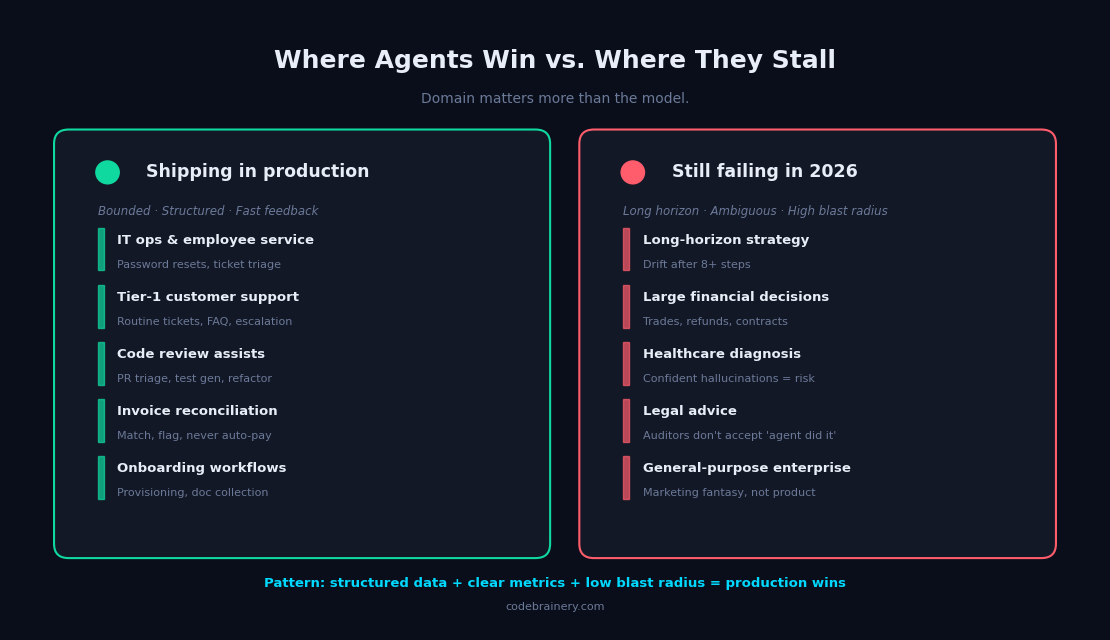
Domain matters more than the model. Concept reflecting analysis from Algoworks and Lyzr's 2026 enterprise report.
Where agents are actually working
Let me get specific. These are the use cases where the production-success data is real, not vendor-deck fiction:
IT operations and employee service. Password resets, ticket triage, runbook execution. Bounded scope, clear success metrics, low blast radius. This is where agents earn their keep first.
Tier-1 customer support. Salesforce's Agentforce hit ~$540M ARR with 18,500+ enterprise customers in 2025. But Salesforce's own internal report flagged the limits: drift after 8+ steps, hallucinations on edge cases, and quality dips when they rebalanced support roles too aggressively. Agents handle the routine. Humans still own the weird stuff.
Code review and software engineering. This is the surprise winner. PR triage, dependency updates, test generation, refactoring assists. The feedback loop is fast, the cost of error is low, and developers can spot bad output instantly.
Invoice reconciliation and finance ops. Structured data, clear rules, deterministic checks. The agent flags exceptions, a human approves them. Boring. Working.
Onboarding workflows. New employee provisioning, document collection, permissions setup. Multi-step, multi-system, but each step is rule-based.
Notice the pattern: structured data, clear success metrics, fast feedback, low blast radius. None of these are "replace the CEO with an agent." They're the boring back office.
Where agents are still failing
Equally specific:
- Long-horizon strategic planning. Anything that needs hours of reasoning across ambiguous information. Agents drift after 8 steps. The Salesforce report confirmed this on their own platform.
- High-blast-radius financial decisions. Trades, large refunds, contract negotiations. Regulators don't accept "the agent did it" as an audit response.
- Healthcare diagnosis and legal advice. Confident hallucinations are a safety risk. ISACA's 2025 incident review hammered this point.
- Cross-domain orchestration without governance. The "general-purpose enterprise agent" is still a marketing fantasy.
The orchestration layer is where the real money is
Here's a take that took me a minute to internalize. Forrester and Gartner both call out multi-agent orchestration as the defining infrastructure priority for 2026. Not the agents themselves. The thing that routes between them.
Compare it to Kubernetes. Containers were cool. The orchestration layer turned containers into infrastructure. Same play here. The teams winning aren't picking one model and one framework. They're routing tasks across models based on cost, capability, and risk:
# Not real code, just the routing logic
def route_task(task):
    if task.needs_long_context and task.is_high_stakes:
        return "claude-opus-4-7"           # Best reasoning, audit trail
    elif task.is_simple_classification:
        return "claude-haiku-4-5"          # Cheap, fast
    elif task.needs_code_execution:
        return "gpt-5-with-tools"          # Strong tool use
    else:
        return "open-source-fallback"      # Cost control
Single-provider architectures got a hard lesson when one provider had an outage and entire workflows broke. Multi-model routing is no longer an "advanced" pattern. It's the production baseline.
A practical checklist before you ship an agent
If you're about to push an agent to production, run through this. I stole most of it from the Amazon evaluation framework writeup and the LangChain postmortems, then trimmed.
- Define the success metric in real outcomes. Not "the agent sounds good." Tickets resolved, payments processed, escalations avoided.
- List every tool the agent can call. Write it down. Now justify each one. Cut three.
- Map the blast radius. If this agent goes rogue at 3am, what's the worst it can do? If the answer is bad, add an approval gate.
- Log every tool call with full input and output. You will need this on day 11 when something weird happens.
- Set token and call budgets. Hard caps. The agent stops, not slows down.
- Plan for schema drift. Pin tool versions. Test upgrades in staging. Have a rollback.
- Define escalation triggers. What makes the agent hand off to a human? Be explicit.
- Test silent failure modes. Inject bad data. See if the agent notices. Most won't.
- Have a kill switch. One command, one team member, full stop.
If you can't answer all nine, you're not ready for production. You're ready for a more careful pilot.
What to actually build this quarter
If you're a developer wanting to learn agentic AI properly in 2026, skip the "build a chatbot" tutorials. Build something with a real failure mode.
Three projects worth your weekend:
- A PR triage agent. Pulls open PRs, runs tests, summarizes diffs, flags risky changes. Bounded, useful, instant feedback.
- An invoice reconciliation agent. Takes a CSV of invoices, matches against a database, flags mismatches, never auto-pays. Structured, scoped, clear win.
- A codebase Q&A agent. RAG over your repo with tool access to actually run grep and read files. Teaches you scoped tool design.
Build any of these with LangGraph or CrewAI. Add observability from day one. When it breaks (it will), you'll learn more in one debugging session than ten tutorials.
FAQ
Is agentic AI just hype? No, but the hype is way ahead of the production reality. Agents are shipping value in narrow domains. They're not running your company.
What's the difference between an AI agent and a chatbot? A chatbot responds. An agent plans, takes actions using tools, adapts when things fail, and remembers what it did. If it can't do all four, it's a chatbot.
Which framework should I use in 2026? LangGraph for explicit control and audit trails (regulated industries). CrewAI for fastest prototyping. OpenAI Agents SDK if you're already locked into GPT. AutoGen for research and multi-agent debate. There's no wrong answer, just trade-offs.
Will agents replace developers? Not in 2026. They're augmenting code review, test generation, and refactoring. The "AI replaces engineers" timeline keeps slipping every time someone tries to ship a production agent without engineers.
What's the single biggest mistake teams make? Giving one agent too much scope. The agents that work do one thing. The agents that fail try to do everything.
Bottom line
Agentic AI in 2026 isn't a revolution. It's a slow, unsexy industrialization. The 11-14% of teams shipping real value did the boring work: scoped the problem, instrumented everything, kept humans in the loop, and assumed their agent would fail.
The hype cycle will keep cycling. The production playbook is already written. Boring is the strategy.
If your CEO sends you another "agents will replace 50% of jobs" headline, send back this question: what's our blast radius if it goes wrong at 3am? That's the conversation that separates the projects that ship from the ones that get canceled in 2027.
Got something to add?
Built a production agent that actually works? Killed one that didn't? The most useful thing you can do for the next dev is share what broke and how you fixed it. Write it up and publish it on codebrainery.com. We're building a library of real stories from real engineers, and yours might save someone six weeks of debugging.