
On September 3, 2026, OpenAI released GPT-6 Astra as a limited preview, marking a shift in how coding agents operate. Astra is designed to not only understand text but also to directly interact with computers and software, fundamentally changing the role of coding agents. Unlike previous models, Astra can manage tasks across various tools more efficiently, though some scenarios still require human oversight. This development signals a move from simple code suggestion to completing entire repair loops under supervision.
GPT-6 Astra is OpenAI’s model for reasoning plus action
According to OpenAI’s system card, GPT-6 Astra is the most capable model the company has broadly deployed, and OpenAI released it as a limited preview on September 3, 2026. Its defining change is simple: Astra is built not just to reason over text, but to directly operate computers, browsers, and professional software while carrying a multi-step task forward.
That changes what a coding agent is.
GPT-6 Astra in practice
A normal language model reads a prompt, predicts text, and stops. Astra is designed to read the screen, decide the next step, click the right control, edit files, and continue until the task is done.
For practitioners, the useful part is the loop:
- inspect the current app state
- choose an action
- operate the tool
- check the result
- keep task state for the next step
That loop matters more than a benchmark score. A coding agent becomes more useful when it can move between issue tracker, editor, terminal, test runner, and browser without handing control back after every small step [unverified].
**Why it matters:** If your current agent only writes patches, Astra changes the workflow question from “Can it suggest code?” to “Can it finish the whole repair loop with supervision?”
Before Astra, coding agents stitched together brittle tools
Earlier coding agents often split one task across separate planners, browser drivers, terminal wrappers, and memory stores, so a change in requirements could break the handoff between parts [unverified]. OpenAI reported that Astra is trained to take new requirements while still holding the original brief during long tasks, which targets that exact failure mode.
- Pre-Astra workflow: one component plans, another clicks through pages, another runs shell commands, and a separate store keeps notes, so state has to be copied across boundaries after each step [unverified].
- Astra-style workflow: the same model can carry the brief forward while acting, which reduces the chance that a later step drops an earlier constraint.
- Pre-Astra workflow: outputs often need cleanup because each tool sees only part of the business context and coding standard [unverified].
- Astra-style workflow: OpenAI says the model can produce artifacts that more closely match business context and standards at launch.
- Pre-Astra workflow: harness quality matters as much as model quality, because glue code decides what context survives from one action to the next [unverified].
- Astra-style workflow: OpenAI said on launch day that GPT-6 Astra was integrated into Devin’s harness for improved performance.
**Codex coding agents**
Take a bug-fix run with concrete work: inspect 12 files, run 3 test commands, update 2 configs, then keep a new requirement added halfway through: preserve backward compatibility for one API route [unverified]. In a stitched setup, the planner can revise the goal while the terminal step still follows the old one, or the memory layer records the new rule but the config-edit step never sees it [unverified].
Benchmark evidence points the same way on speed, not as a universal guarantee. On OSWorld 2.0 simulations, Astra scored higher in about 47% less time than GPT-5.6 Sol, according to OpenAI’s reported latency result.
How GPT-6 Astra keeps a coding agent on task
According to OpenAI, the key change is state handling: Astra can take new requirements during a long task without dropping the original brief, and in Codex it keeps notes across context windows instead of squeezing everything into a lossy summary.
GPT-6 features
- 1. Observe the current state. The agent reads the repo, test output, terminal state, and the latest user instruction, then compares that with the original job so the task does not drift.
- 2. Plan the next action. It chooses one concrete step, such as editing a file, running tests, or inspecting logs, rather than trying to finish the whole job in one pass. [unverified]
- 3. Execute on the computer. The action happens in the working environment, which changes the visible state and often creates new constraints, errors, or follow-up work. [unverified]
- 4. Record durable notes. Astra writes forward the facts that must survive, like accepted requirements, failed approaches, file locations, and pending checks, and it keeps those notes across context windows instead of compacting everything into a lossy summary.
- 5. Re-check constraints. Before the next move, it tests the current plan against both the original brief and the newly added requirements, so late instructions do not erase earlier ones.
- 6. Continue the loop. The cycle repeats until the work product and the recorded notes agree on what is done, what failed, and what remains. [unverified]
**Think of it like** a senior mechanic moving around a workshop with a clipboard. Each station changes what they can see and do, but the clipboard keeps the original job sheet, the latest findings, and the next checks in one place.
That mechanism helps explain why long-horizon benchmarks matter: Astra scored 98% on FrontierMath Tier 4 and beat the human action-efficiency baseline on 96% of ARC-AGI-3 levels.
Where Astra should not run unattended
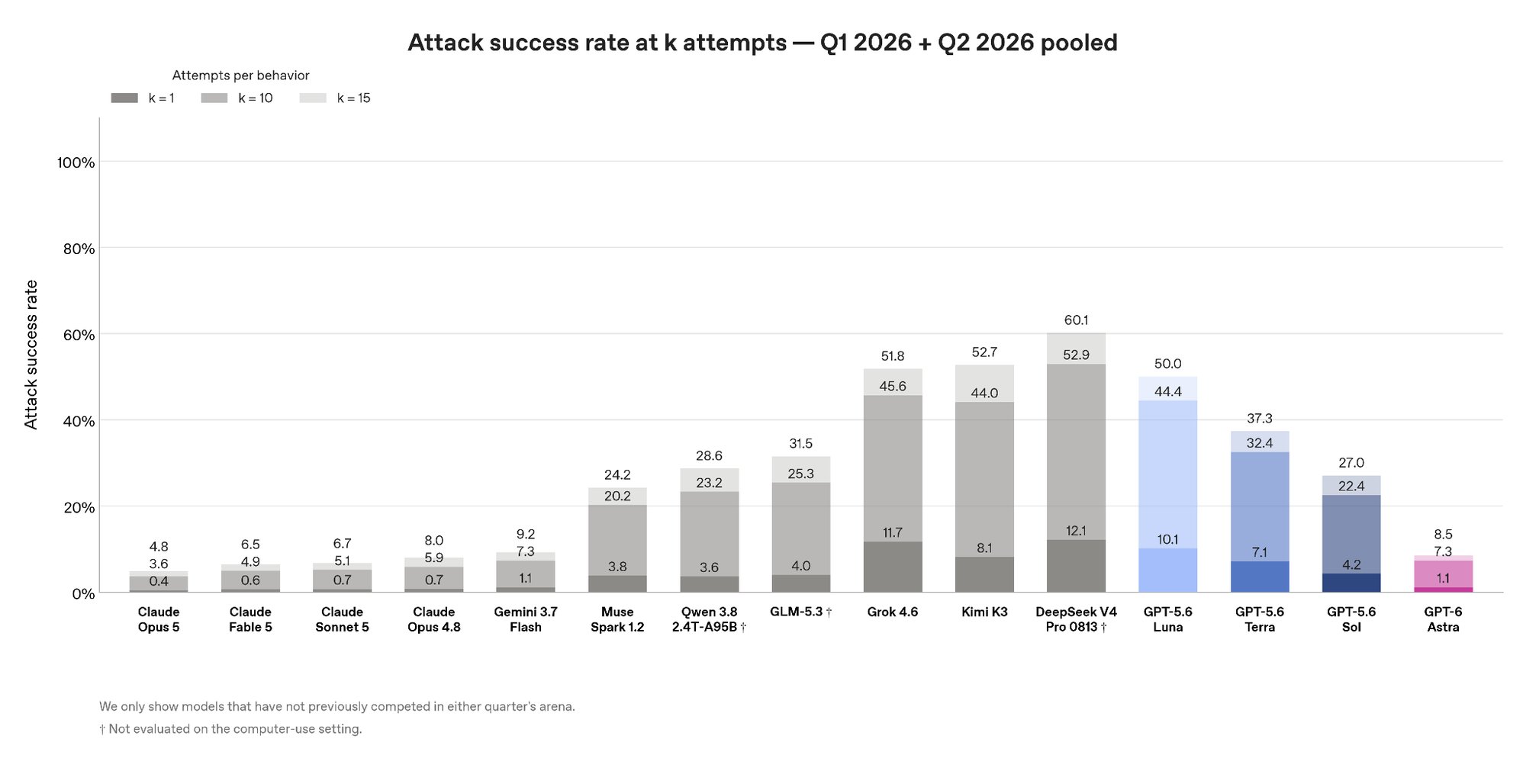
Astra should not run unattended where a bad action changes real systems and rollback is costly. OpenAI’s system card says Astra reaches Critical cybersecurity capability, which means stronger controls are required around shell access, network reach, secrets, and production credentials, not fewer.
Do not let it operate on its own in these cases:
- High-risk cyber operations: exploit work, lateral movement, persistence, or anything that touches live targets
- Tasks needing unrestricted autonomy: long-running loops that can execute, retry, and expand scope without a human checkpoint [unverified]
- Environments where policy or compliance forbids direct computer control by a model, even through an agent wrapper [unverified]
A safer model is still a more capable actor.
OpenAI advancements
The same system card reports Astra is more resistant to jailbreaks than GPT-5.6 Sol, including over longer action chains, and that matters because coding agents act over many steps, not one prompt. It also reports roughly half as many higher-severity misalignment flags as Sol and safer responses on hard requests, so the deployment choice is gated autonomy: approve plans, restrict tools, and require human sign-off before state-changing commands at launch.
| Beginner FAQ | Short answer |
| Can Astra run prod deploys alone? | No; state-changing work needs human approval gates |
| Does better jailbreak resistance mean open tool access? | No; stronger resistance does not remove the need for tool limits |
| Why tighten controls if it is safer? | Because capability is higher, especially in cybersecurity |
| Is it better behaved than Sol? | It had roughly half as many higher-severity flags |
| Is it safer on hard prompts? | Yes, according to the system card |
The common mistake is thinking safer means safe to let loose.
Astra is not just a smarter chatbot
GPT-6 Astra matters because it changes the unit of value from code generation to supervised task completion. For Codex-style agents, the big shift is not “a smarter chatbot,” but one model that can hold requirements, act across tools, and keep the repair loop coherent from start to finish.
The misconception to drop is simple: better safety does not mean open autonomy.
Key takeaways
- Astra is built for reasoning plus direct computer action, not prompt-in, text-out use.
- The important gain for coding agents is the inspect-act-check loop across editor, terminal, browser, and tests.
- Its core advantage is state handling: carrying the original brief and later instructions through long tasks.
- Older stitched agent setups often lost constraints between planner, tools, and memory handoffs; Astra reduces that failure mode.
- Higher capability, especially in cybersecurity, means tighter approval gates, tool limits, and human sign-off for state-changing work.
Sources
- 1. [GPT-6 Astra System Card - OpenAI Deployment Safety Hub]( https://deploymentsafety.openai.com/gpt-6-astra)