
Jev TypeSafe AI is wired as a typed decision node, not a chat surface. The common mistake is treating Jev like a text generator, which it is not. Jev provides a typed decision output, making it suitable for bounded decision tasks where latency and cost are critical factors.
TL;DR
- Jev TypeSafe AI should be wired as a typed decision node, not a chat surface.
- Jev provides decisions with probabilities, not free-form text or code.
- Use Jev for tasks with fixed labels, logged outcomes, and clear fallbacks.
- Jev is faster and cheaper than conventional LLMs for certain bounded tasks.
- Log decisions, probabilities, and confidence to audit outcomes effectively.
Set up Jev technology for typed decision calls
Start with one bounded decision and wire Jev as a typed component, not a chat surface. According to heise.de, Jev has been available in early access via a hosted API since September 2026, so your minimum setup is API access, a runtime, secret handling, and a test endpoint you can hit from your app or curl.
- API access to Jev
- Runtime with HTTP client
- Secret handling via environment variables
- Test endpoint for one decision call
RLCD means Reinforcement Learning for Calibrated Decisions. Choice selects from declared alternatives; Score returns a continuous judgment over ordered levels; Noul evaluates a binary proposition.
Jev is non-autoregressive, meaning it returns a decision in one pass rather than token-by-token text.
export JEV_API_KEY="jev_live_xxx"
export JEV_BASE_URL="https://api.example.test/jev"

curl -sS "$JEV_BASE_URL/v1/choice" \
  -H "Authorization: Bearer $JEV_API_KEY" \
  -H "Content-Type: application/json" \
  -d '{
    "input": {
      "account_age_days": 12,
      "failed_logins_24h": 3,
      "country_match": true
    },
    "alternatives": ["allow", "review", "block"]
  }'
Architecture is simple: app state in, typed decision out.
Map Jev typesafe ai into one checkable workflow
TypeSafe AI built Jev for automated workflows, so implement it as a bounded decision node, not a chat surface, according to InfoWorld. On September 21, 2026, keep the workflow checkable by requiring one artifact per step.
- 1. Pick one bounded branch, such as route-or-fallback, and write the exact enum your code will accept; expected artifact: a committed type definition.
- 2. Send that enum and the input state to Jev; it returns one answer per question with probabilities. Expected artifact: a saved response JSON.
- 3. Add calibration, meaning whether stated probabilities match observed outcomes over repeated cases. Expected artifact: an evaluation script and report.
- 4. Set a confidence threshold and fallback path; for Choice and Score, confidence comes from the returned distribution’s shape. Expected artifact: branching code plus a fallback log line.
- 5. Emit structured logs for input key, chosen branch, probabilities, confidence, fallback_taken. Expected artifact: one queryable log record.
Spot failure modes before Jev typesafe ai hits prod
Treat the first red flag as architectural, not prompt-related: according to flaviocopes.com, Jev is not a chatbot and does not generate text or code, so if your test harness expects prose, code, or self-explanations, the integration is wrong on arrival. On September 21, 2026, flaviocopes.com reported Jev returns one answer per question with probabilities, so make the caller validate a bounded answer and reject any UI path that asks for free text.
This symptom is not uncertainty; it is a type design failure.
Troubleshooting FAQ
Q: The model “answers” by failing schema validation or returning an impossible option.
A: Your answer space is misdeclared; define the exact list or scale your program accepts, because Jev emits clearly defined decisions, not free-form output.
Q: Confidence is high, but the business result is still wrong.
A: You are reading confidence as correctness; for Choice and Score it is derived from the returned distribution shape, so recalibrate thresholds against outcomes.
Q: The team keeps adding prompt text to force explanations.
A: Stop treating Jev like a text model; it cannot write an article, generate code, or explain itself.
Use typesafe programming ai where latency changes design
Put Jev where a bounded software decision sits between deterministic code and an expensive next step. According to infoworld.com, Jev is designed for automated workflows and intended to help applications make decisions, not to chat with users.
A hot path is the request path that must finish immediately because user-visible latency or a control loop depends on it.
- deterministic code validates inputs and computes features
- Jev returns the decision
- fallback branch routes to stricter rules or human handoff
**Why it matters:** If your service already has a hard latency budget, place Jev only where a decision in the low hundreds of milliseconds changes the branch you take, not where free-form generation is expected.
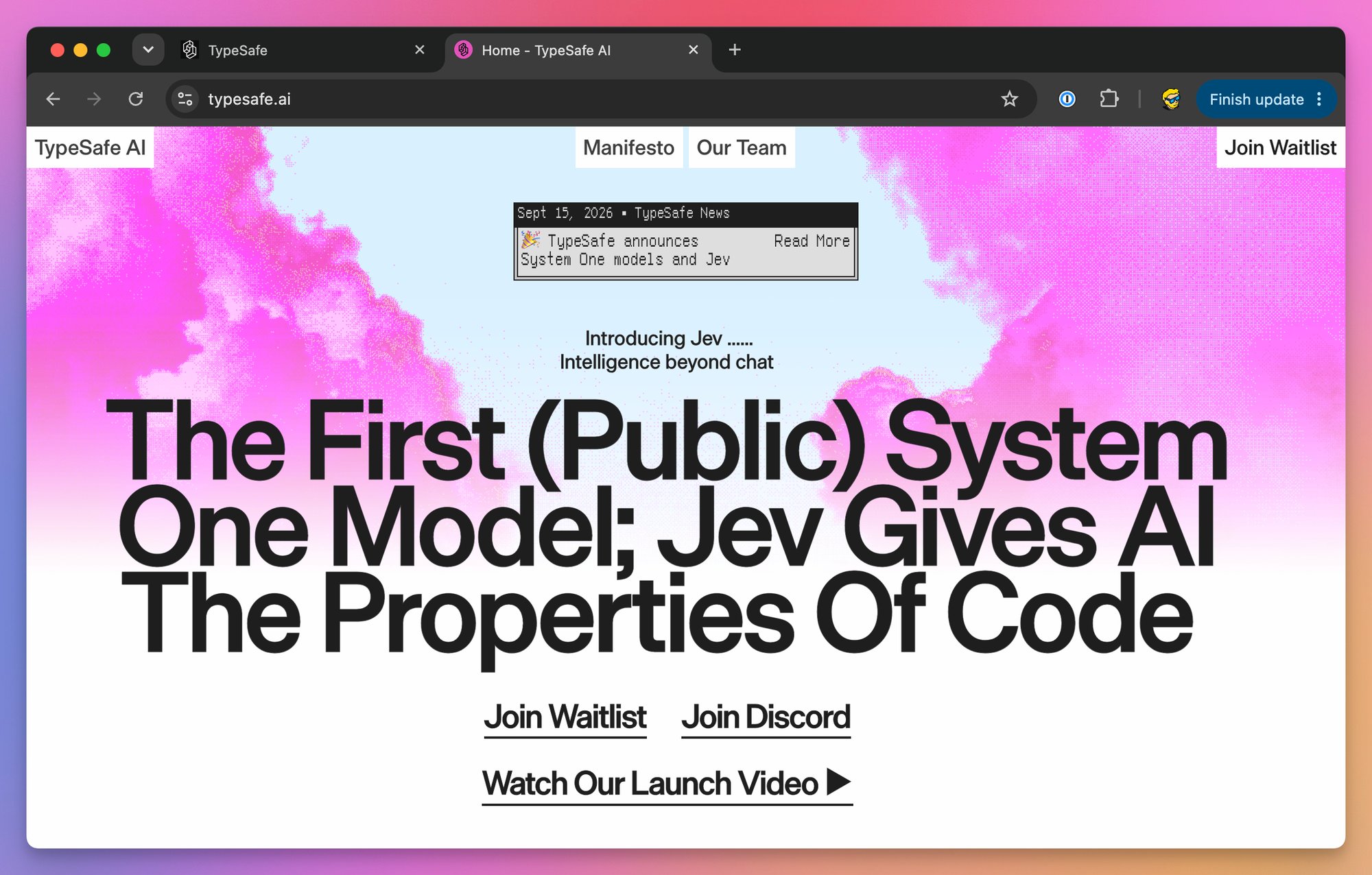
Use Jev in a routing layer or real-time loop when response time changes system shape. TypeSafe states response times between 70 and 500 milliseconds, and heise.de reported the same range.
Check Jev ai benefits against your own constraints
Use Jev when the answer space is small, typed, and testable, not open-ended. According to mindstudio.ai, Jev is up to 100 times faster and 100 times cheaper than conventional LLMs for certain tasks, so the fit test starts with whether your task is a bounded decision where speed and cost change the design.
- [ ] The task ends in a fixed label, rank, or route, not free-form prose.
- [ ] You can score success with an explicit outcome metric in logs or offline evals.
- [ ] Your service benefits from lower latency on a hot path or gate.
- [ ] A deterministic fallback or human review path is acceptable when confidence is low.
- [ ] Token economics matter enough that free output changes your budget shape.
Do not use Jev for generation: it does not write replies, explanations, or code.
If you cannot specify acceptable fallback behavior before integration, stop and tighten the decision boundary first.
Run typesafe ai examples with thresholds and logging
Use a fallback threshold—the minimum confidence required to trust the primary branch—so low-certainty calls route to deterministic code or review. Jev returns one answer per question with probabilities, which makes threshold checks a direct part of service logic rather than a text-parsing afterthought.
According to substack.com, for Choice and Score, confidence is derived from the shape of the returned distribution, so log it separately from probability on every decision.
type Route = "approve" | "review" | "deny";
const FALLBACK_THRESHOLD = 0.78;

async function decide(input: DecisionInput, logger: Logger): Promise<Route> {
  const r = await jev.choice({
    question: "route_order",
    options: ["approve", "review", "deny"],
    input
  });

  const decision = r.answer as Route;
  const probability = r.probabilities[decision];
  const confidence = r.confidence;

  logger.info("jev_decision", {
    decision,
    probability,
    confidence,
    threshold: FALLBACK_THRESHOLD,
    fallback: confidence < FALLBACK_THRESHOLD
  });

  if (confidence < FALLBACK_THRESHOLD) {
    logger.warn("jev_fallback", {
      decision,
      probability,
      confidence,
      fallback_to: "review_queue"
    });
    return "review";
  }

  return decision;
}
Most calls complete in about 100 milliseconds, so this pattern fits a real request path if your fallback branch is equally bounded. Jev provides clearly defined decisions along with probabilities that a program can process directly, which is why the log fields above are enough to audit routing quality without storing free-form text.
Verify typesafe ai applications with speed and cost
Time the same request through your Jev path and your conventional LLM path, then compare wall time, serialized output, and billing records from the same service window. According to infoworld.com, Jev responds in 70 milliseconds to 500 milliseconds because it does not generate text tokens sequentially, while the LLMs TypeSafe tested took several seconds on the same class of work.
Most calls should land near 100 milliseconds at launch.
Verification table
Use this as a release check after you wire typed branching and logs:
| Path | Expected latency | Output format check | Cost check |
| Jev integration | Usually about 100 milliseconds; acceptable band 70 to 500 milliseconds | Typed decision payload, not freeform prose; stable shape across repeated calls | Input tokens at $0.042 per million and output tokens free |
| Conventional LLM path | Several seconds on the tasks TypeSafe compared | Freeform text unless you add extra constraints and parsing | Higher cost shape; Jev is reported up to 100 times cheaper for certain tasks |
Jev is worth it when the decision is bounded
Jev is worth it when the decision is bounded, typed, and tied to a real branch in your system. If your setup ends in a fixed label, logs outcomes, and has a clear fallback, Jev is the right tool; if it expects prose, explanations, or code, the integration is wrong.
This is a type check before it is a model choice.
Key takeaways
- Start with one bounded branch and commit the exact enum or scale your code accepts.
- Send app state in and require a typed decision out; reject any path that asks for free text.
- Add calibration checks, then set a confidence threshold tied to a deterministic fallback or review queue.
- Log the chosen branch, probabilities, confidence, and whether fallback fired so you can audit outcomes.
- Keep Jev on hot paths where low-hundreds-of-milliseconds decisions change routing, and compare that path against your current LLM flow on latency, output shape, and cost.
Sources
- 1. [AI model “Jev” to make machines decide faster | heise online]( https://www.heise.de/en/news/AI-model-Jev-to-make-machines-decide-faster-11457071.html)