
88% of AI agent projects across 2024 and 2025 never reach production, and the main reason is not the model itself but the surrounding system. In production, AI agents face chaotic data, weak state management, and unreliable tool connectors, which lead to failure before model quality becomes a significant issue. The solution is a stricter runtime with hard boundaries, auditability, and narrow scope. Better models alone do not fix these systemic problems.
TL;DR
- 88% of AI projects fail to reach production.
- System failures, not model flaws, are the main issue.
- Input normalization and data quality are critical.
- Tool connectors need explicit failure modes.
- Observability must be part of the runtime.
Most ai agents failure stories are system failures, not model failures
flowchart TD
    A[AI Agent Failure] --> B[System Failures]
    A --> C[Model Failures]
    B --> D[Broken Tool Calls]
    B --> E[Weak Observability]
    B --> F[Operational Challenges]
    F --> G[Cumulative Issues]
    F --> H[Expensive Solutions]
    B --> I[Unprepared Systems]
    C --> J[Temporary Deployment Issues]
    J --> K[Improving Models]
    K --> L[Counterargument Fails]
    L --> M[Outcome Constraints]
Most teams misdiagnose why ai fails by blaming the model, and I think that is backward: in production, the dominant failure mode is the surrounding system, not the base model. According to Lens, most failures aren't related to the model. That claim is arguable, but it matches what practitioners see when a polished demo meets real inputs, real retries, real permissions, and real downstream state.
The production gap is not mysterious. AI agents are powered by large language models, but the model is only one component in a chain that has to ingest data, carry context across steps, call tools, and survive bad inputs without corrupting work.
| Condition | Sandbox | Production |
| Data | High-quality and carefully validated | Chaotic PDFs, emails with missing context, and Excel files mixing old and new data |
| Interaction | Single prompt | Multi-step workflow with tool calls, retries, and state handoff [unverified] |
| Context | Static context | Drifting context as documents, users, and systems change [unverified] |
| Success metric | Local success | Operational reliability over repeated runs [unverified] |
The model is rarely the first thing breaking.
What actually fails first is usually one of these system edges:
- Input normalization: the parser drops a table from a PDF, an email thread loses the sentence that changes intent, or spreadsheet columns mix current and stale values.
- State management: step three uses stale context from step one, so the agent answers consistently and wrongly [unverified].
- Workflow control: a single prompt in a notebook becomes a branching sequence with retries, timeouts, and side effects [unverified].
- Reliability criteria: a demo only has to work once, while production has to keep working across messy cases [unverified].
That is why the gap between “it worked in the sandbox” and “it survives live traffic” is so large. Training data inside the sandbox is typically high-quality and carefully validated, while the real world is chaotic in exactly the formats agents struggle to interpret cleanly. Analysis of enterprise AI agent deployments across 2024 and 2025 reported that 88% of AI agent projects never reach production, which is a systems result before it is a model result.
The numbers behind ai in production failure: compounding steps, broken tool calls, and weak observability
According to IDC research published via CIO.com, 88% of AI POCs never reach production scale, and only 12% of enterprise agent initiatives reach production at scale or sustained operation. Those two numbers are the cleanest signal in this whole debate: the failure is not at the demo prompt, it is in the production chain that sits around the model.
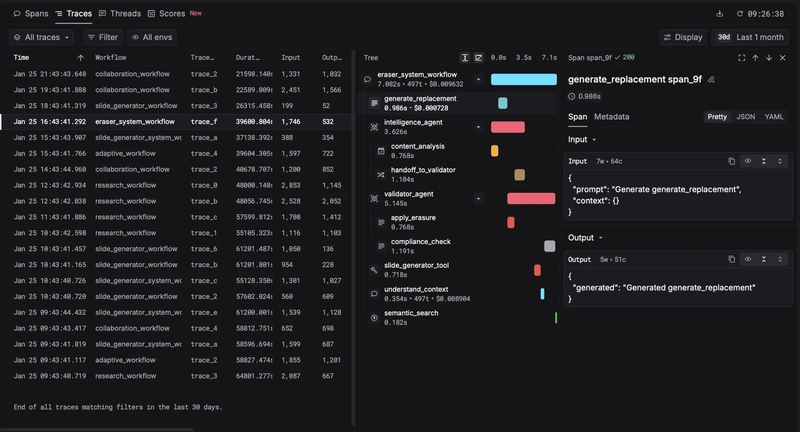
The mechanism is simple. An agent is not one inference; it is a sequence: user request -> retrieval -> planner -> tool call -> verifier -> write action -> audit log [unverified]. Each hop adds another chance to fail, timeout, drift, or go unobserved.
# Compounding reliability across multi-step agent runs
def run_success(per_step_success, steps):
    return per_step_success ** steps

for p in (0.99, 0.95, 0.90):
    print({
        "per_step_success": p,
        "5_steps": round(run_success(p, 5), 4),
        "10_steps": round(run_success(p, 10), 4),
    })

# Example output:
# 0.99 -> 5: 0.9510, 10: 0.9044
# 0.95 -> 5: 0.7738, 10: 0.5987
# 0.90 -> 5: 0.5905, 10: 0.3487
That is why teams get fooled by strong single-step evals. A planner that looks fine in isolation still fails in production when retrieval returns the wrong chunk, the tool schema shifts, the verifier misses it, and the write path commits anyway.
Silent wrong actions are worse than visible crashes.
The main production breakpoints are predictable:
- Retrieval: in 61% of multi-layer incidents, retrieval failure was the upstream cause that made the downstream tool call go wrong.
- Tool calling: tool calling fails at meaningful rates in production, and tool-call failures are the most common entry point for agent failures.
- Observability: observability failures had an average MTTR of 4.2 hours.
- Memory drift: memory drift incidents had the longest MTTD of any category.
- Cost control: long-running agents amplify retries, context growth, and repeated tool use [unverified].
Why connectors break first
In practice, the weakest link is usually the connector, not the base model. Tool connectors sit at the boundary between probabilistic output and deterministic systems, so every mismatch becomes operational pain: missing auth, stale schema, enum drift, partial writes, rate limits, and retries that replay side effects.
That is why every external call needs an explicit failure mode, not just a try/catch wrapper. If the agent can call a CRM, ticketing API, or SQL write path, the connector has to define what happens on timeout, malformed arguments, duplicate submission, partial success, and verifier disagreement.
tool_call:
  name: create_ticket
  timeout_seconds: 15
  retries: 0
  on_schema_error: fail_closed
  on_timeout: return_control
  on_partial_write: mark_incomplete
  require_idempotency_key: true
  require_verifier_approval: true
  emit_audit_log: true
Without that kind of contract, the planner invents certainty the system does not have [unverified]. The result is not just a failed step; it is a corrupted run state where memory records success, the external system records partial failure, and tracing cannot tell which branch actually executed [unverified].
Observability is where these incidents become expensive. When schema validation is in place, tool-call failures are faster to isolate, but observability failures stretch MTTR to 4.2 hours because the team cannot reconstruct the run graph, inputs, tool payloads, and state transitions from logs alone.
I treat tracing as part of the runtime, not as after-the-fact debugging [unverified]. For the architecture above, each stage needs a run ID, parent span, prompt version, retrieval source IDs, tool arguments, verifier result, write outcome, and audit event, or the postmortem turns into guesswork [unverified].
Memory drift is the slowest class of breakage because it hides inside apparently successful runs. Sherlocks.ai reported that memory drift incidents had the longest MTTD of any category, which matches what operators see: the agent keeps acting, but on stale or self-invented state until someone notices downstream damage.
This is why “works in staging” means very little for agents. Production failure is a compounding systems problem: retrieval quality, connector contracts, verifier strictness, write safety, and trace coverage all have to hold at once, and the aggregate success rate collapses when any one of them is treated as optional.
The fair case against me: models are improving fast, so today's ai deployment issues may be temporary
The strongest case against my argument is that I am overfitting to a messy moment. If model quality keeps rising, then a large share of what looks like “agent failure” today will read later as ordinary early-adoption churn, not a durable limit [unverified].
Demos are getting materially better.
That opposing case is stronger than skeptics admit because it is not just “bigger models fix everything.” It is a stacked claim about model capability, tool discipline, and deployment maturity improving at the same time [unverified].
The steelman
- Stronger base models reduce the error rate at every handoff: instruction following is tighter, context retention is better, and recovery from ambiguous tool output improves, so long chains stop collapsing on small misunderstandings [unverified].
- Better tool use matters as much as raw generation quality: stricter function calling, typed schemas, and clearer argument validation turn “the model guessed” into “the runtime rejected bad actions before side effects happened” [unverified].
- Better reasoning behavior changes the economics of production: if models plan more reliably, ask for missing inputs, and defer when confidence is low, teams need fewer brittle prompt patches and less human babysitting [unverified].
- More mature agent stacks remove accidental complexity: tracing, retries, state handling, eval harnesses, and policy gates are becoming default infrastructure instead of ad hoc glue code [unverified].
- Rollout discipline is catching up: staged deployment, narrower scopes, and explicit permission boundaries prevent teams from shipping an unconstrained general agent and then blaming the model when the system behaves like one [unverified].
A fair critic would also say many “agent failures” are really failures of enterprise process. The source of the block is often not an exploit or model misbehavior but missing documentation, access control structure, and audit logging needed for review, and most projects stopped by security do not have actual vulnerabilities according to the analysis guide.
That matters because those are solvable operational gaps, not proof that agents cannot work. If teams standardize approval paths, identity boundaries, and event logs, some of today’s red lights disappear without any breakthrough in reasoning [unverified].
Even the bleak numbers can support the transitional view. Gartner reported that over 40% of agentic AI projects will be scrapped by 2027, but a forecast about projects being scrapped is not the same as a forecast that the underlying approach is fundamentally broken on September 6, 2026.
I still think the production failure rate is telling us something structural, but the best opposing argument is serious: better models plus better runtimes plus better rollout practice can compress today’s failure class into a short-lived phase [unverified].
Why that counterargument still fails: challenges with ai are operational, cumulative, and expensive
The steelmanned case says model progress will wash away today’s failures, but the failures that matter in production sit outside the model boundary. Better next-token prediction does not create governance, repair source systems, add audit logs, or make a write action safe to execute against a live system.
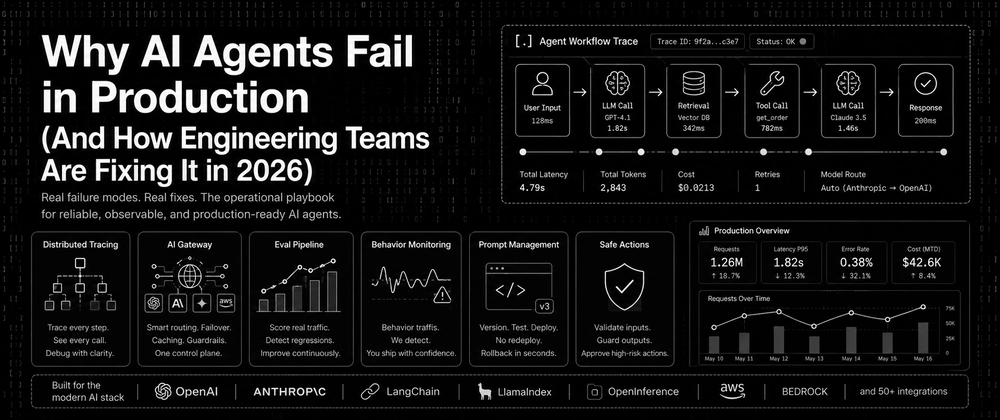
According to Gruve, reliable enterprise AI systems need strong governance, observability, deterministic validation, human escalation paths, strict security controls, and measurable ROI outside controlled environments. That requirement does not disappear when the model scores higher on reasoning benchmarks, because the production breakpoints are in the interfaces, policies, and data contracts around the model.
Better reasoning on top of bad systems just produces faster mistakes.
A competent agent still fails in a very ordinary sequence:
- 1. An operator gives an ambiguous input that mixes intent, exceptions, and stale business terms, so the agent starts from an underspecified task [unverified].
- 2. Retrieval hits bad source data or incomplete records, because the system of record is inconsistent or missing context the model cannot infer.
- 3. The model produces a plausible plan anyway, since plausibility is cheap and correctness depends on grounded facts and policy checks.
- 4. A tool invocation returns a failed or partial result from an API timeout, schema mismatch, permission boundary, or side-effecting action that only partly commits [unverified].
- 5. The orchestration layer lacks deterministic validation, so there is no hard gate like
status == "confirmed"or a reconciled state check before the next step runs. - 6. The agent takes the wrong action or hands a broken case to a human, who now has to inspect logs, compare system state, and clean up the residue manually.
That sequence is why “just use a better model” is not an operating plan. If the retrieval layer is fed inconsistent records, the plan quality is bounded by the records; if the write path has no approval gate, the model can reason perfectly and still issue an unsafe command.
The constraints that actually decide outcomes
Production agents need explicit boundaries such as read-only defaults, allowlisted tools, state checks before writes, and escalation when confidence is not enough to justify action. They also need auditability: what prompt ran, what documents were retrieved, what tool arguments were sent, what external state changed, and who approved it.
Without that, governance is not a paperwork issue; it is the difference between an explainable transaction and an untraceable one. Missing audit trails turn every incident into archaeology, and absent security controls leave prompt injection and unsafe tool use as live operational risks.
The business case collapses faster than teams admit. The average failed AI agent project costs $340,000 in direct expenses alone.
The largest share of those failures is not “the model wasn’t smart enough.” Scope creep and data quality issues account for 61% of all failures combined.
That matters because both failure modes worsen as optimism rises. A stronger model tempts teams to widen scope before the surrounding controls are ready, and it can mask poor data by generating fluent output that looks operationally acceptable until a downstream system rejects it or a person has to repair the result.
The agents that survive production are not the ones with the prettiest demos. They are the ones boxed in by constraints, wired with escalation paths, and judged by measurable ROI instead of benchmark screenshots.
Most AI agents fail because the production system is not ready for them
Most AI agents fail in production because the system around the model is not ready: bad inputs, weak state handling, brittle connectors, missing validation, and poor tracing break runs before model quality becomes the main issue. The winning pattern is not a smarter demo but a stricter runtime with hard boundaries, auditability, and narrow scope.
Better models do not fix unsafe writes, partial commits, or missing governance.
Key takeaways
- Treat input normalization and data quality as first-order work; chaotic PDFs, email threads, and mixed spreadsheets poison the run before planning starts.
- Design every tool connector with explicit failure modes, idempotency, and verifier approval instead of trusting retries and best-effort wrappers.
- Add deterministic validation and read-only defaults before any write action so plausible output cannot become an unsafe action.
- Make observability part of the runtime: trace run IDs, prompt versions, retrieval sources, tool arguments, and write outcomes.
- Keep scope narrow and judge agents by operational reliability and measurable ROI, not single-step evals or polished demos.
Sources
- 1. [Why AI Agents Fail in Production (and How to Fix It) — Lens Blog — Lens]( https://lenshq.io/blog/why-ai-agents-fail-in-production/)