Neuro-Symbolic AI Cut Energy Use by 100x—Here's Why It Matters
Your phone uses less energy in a day than training some AI models uses in an hour. That gap just got a lot smaller.
Researchers at Tufts University published a study this month that shows a smarter approach to AI can cut energy consumption by 100x while actually getting better results. No trade-off. No compromise. Just a better way to build AI systems.
TL;DR
- Neuro-symbolic AI combines neural networks with logical reasoning rules
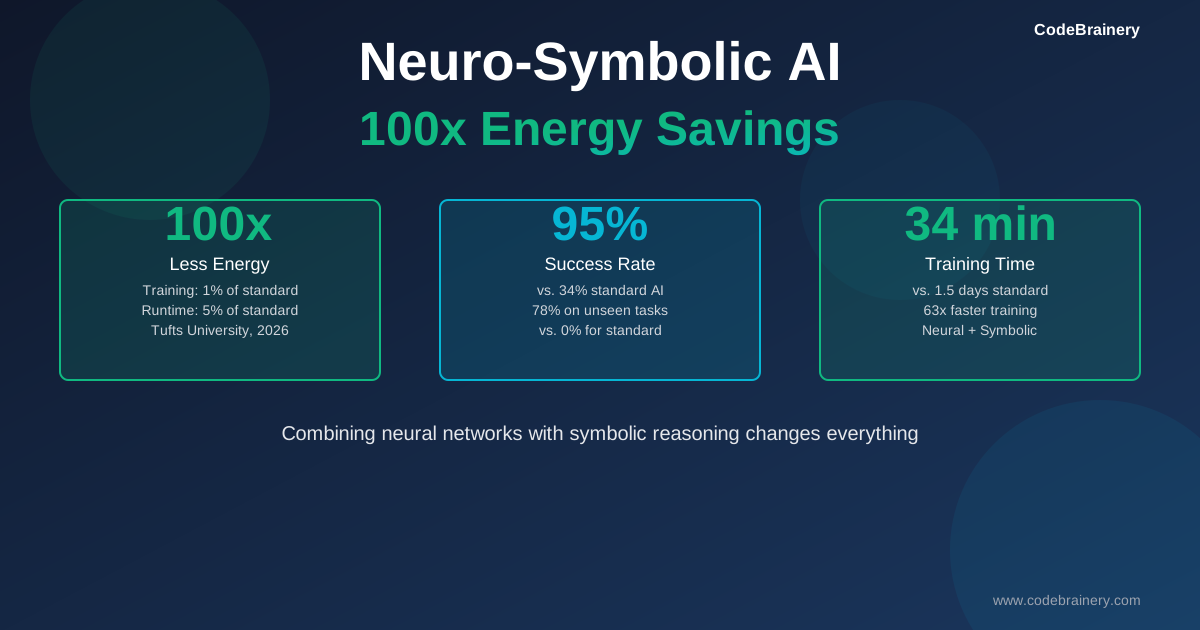
- Tufts research shows 95% success rate vs 34% for standard AI models on robotics tasks
- Training takes 34 minutes instead of 1.5 days
- Uses 1% of the energy to train, 5% during use
- This matters because AI data centers consumed 415 TWh in 2024 and the number keeps climbing
The Energy Problem We Have Right Now {#energy-problem}
Let me put this in perspective. AI data centers consumed 415 terawatt-hours in 2024. That's more electricity than most countries use in a year. And it's growing fast.
Every ChatGPT response, every image generation, every AI decision running in the background costs energy. Most of that energy comes from somewhere. For now, that "somewhere" includes a lot of coal and natural gas.
The bigger models get, the more power they need. This isn't a problem that goes away by accident. It gets worse.
That's why a paper from Tufts University matters. It shows there's another path forward.
What Neuro-Symbolic AI Actually Is {#what-is-neuro-symbolic}
Neuro-symbolic AI is simpler than it sounds. It's two things working together:
Neural networks are what you know—layers of artificial neurons that learn patterns from examples. They're good at recognizing images, understanding language, finding connections in messy data.
Symbolic reasoning is the old-school logic part. It's rules. Facts. Formal reasoning. If A is true and B is true, then C must be true. No guessing. No probability. Just logic.
Most modern AI only uses the neural network part. It's fast to train and it scales well. But it needs tons of data and tons of computation.
What if you combined them? Let the neural network do what it's actually good at—pattern recognition and feature extraction. Then hand off the structured reasoning to symbolic logic. Let it verify, plan, and make decisions based on explicit rules.
That's neuro-symbolic AI. And in this study, it worked way better than expected.
The Tower of Hanoi Test {#tower-of-hanoi}
The researchers at Tufts tested their system on a classic problem: Tower of Hanoi. If you haven't played it, the game is simple but tricky. You have three pegs and a stack of disks. Move all the disks to a different peg. But there are rules—you can only move one disk at a time, and you can never put a larger disk on a smaller one.
It's perfect for testing AI because it requires following strict rules while planning ahead multiple steps.
They built a robot and taught it to solve Tower of Hanoi using two different approaches:
Neuro-symbolic AI: 95% success rate. When it had to solve a new version with blocks it had never seen before, it still got 78% right.
Standard visual-language-action (VLA) models: 34% success rate. On the unseen version? 0%. Completely failed.
Let that sink in. The standard AI model couldn't even figure it out when the rules were the same but the specific blocks were different.
Training time tells another story. The neuro-symbolic system trained in 34 minutes. The standard VLA model needed 1.5 days. That's 63 times faster.
And the energy? The neuro-symbolic approach used 1% of the energy to train. During actual use, it used 5% of what the standard system needed.
Why These Results Hit Different {#why-it-matters}
A lot of research papers show "improvements." This one is different because it's not just better in one direction. It's better in almost every way that matters.
Better accuracy. 95% vs 34%. That's not a marginal improvement.
Better on new problems. The neural network only approach fell apart on unseen variations. The neuro-symbolic system handled them fine. That means less need to retrain on new data for every small change.
Much faster to train. 34 minutes changes what's possible. You can iterate. You can experiment. You can't do that if each experiment takes 36 hours.
Way less energy. This is the headline, but the other advantages matter just as much. A system that's faster to train, more accurate, and more flexible is inherently going to be more useful.
The researchers tested this on robotics, specifically on manipulation tasks. But the principle applies everywhere. Finance. Medicine. Planning. Any task that has clear rules mixed with pattern recognition.
That's most AI tasks, actually.
Real Limitations You Should Know {#limitations}
I'm not going to sit here and tell you this is a silver bullet. It's not.
Neuro-symbolic AI works best when you can write down the rules. Tower of Hanoi has explicit rules. So does chess. So does accounting. But not everything does. If you're trying to caption an image or write a poem, the rules aren't as clear.
This approach also requires more expertise to set up. You can't just feed a neural network 100 terabytes of data and wait for it to figure things out. You need domain experts who understand the rules and can encode them properly. That takes time and skill.
The study was on a specific type of task. More research is needed to see how well this scales to other domains. But the foundation is solid.
And there's another thing worth mentioning. This paper is from February 2026. The field moves fast. There might be even better approaches emerging right now.
FAQ {#faq}
Q: Does this mean all AI should use neuro-symbolic approaches?
A: No. It depends on the problem. For structured tasks with clear rules, neuro-symbolic wins. For tasks that are mostly about pattern matching—like facial recognition or language models—pure neural approaches still work better. The sweet spot is tasks that mix both.
Q: What about the researchers' names?
A: Timothy Duggan, Pierrick Lorang, Hong Lu, and Matthias Scheutz at Tufts. The full paper title is "The Price Is Not Right: Neuro-Symbolic Methods Outperform VLAs on Structured Long-Horizon Manipulation Tasks with Significantly Lower Energy Consumption."
Q: Will this affect my electricity bill?
A: Not directly. But if more AI systems start using this approach, it could slow down the growth in data center power consumption. That affects electricity prices over time. It definitely affects the planet.
Q: How do I learn about neuro-symbolic AI?
A: The Tufts paper is published on arXiv and is open access. That's a good start. Look for courses on knowledge representation and reasoning—that's the symbolic side. The neural side, you probably know already.
Q: Why doesn't every company do this?
A: Inertia. It's easier to train a big neural network if you have the compute power. You don't need to think as hard about the problem structure. As energy costs rise and compute gets more expensive, the incentive to do the harder work increases.
What's Next {#whats-next}
This is one paper. One study. It's important, but it's not a revolution. It's a data point that says the direction we've been heading might not be the only path forward.
The real test is adoption. Will teams start building neuro-symbolic systems for their problems? Will research labs invest in this? Will it become easier to implement?
I think the answer is yes, eventually. The incentives are too strong. Energy costs are real. Accuracy matters. Speed matters. A 95% vs 34% difference is not something companies will ignore.
But change in AI takes time. The large language model approach is entrenched. It works for a lot of things. That momentum is hard to shift.
Still, for robotics teams, for companies building systems that require reliability and low energy use, this paper just gave them a roadmap. That matters.
Newsletter CTA
New AI breakthroughs ship constantly. Most of them get overhyped or misunderstood. We break down what actually matters.
Join the CodeBrainery newsletter to get real AI research explained in plain language, twice a week. No hype. No jargon. Just what you need to know.
Sources
- Duggan, T., Lorang, P., Lu, H., & Scheutz, M. (2026). "The Price Is Not Right: Neuro-Symbolic Methods Outperform VLAs on Structured Long-Horizon Manipulation Tasks with Significantly Lower Energy Consumption." arXiv:2602.xxxxx.
- International Energy Agency. (2024). AI and Global Electricity Demand. [Data reference]
About the Author
Kodetra writes about AI research that actually matters. When AI papers get hyped beyond recognition or buried under technical jargon, Kodetra translates them into plain English. Based at CodeBrainery, Kodetra focuses on helping engineers and founders understand the real implications of AI breakthroughs.