
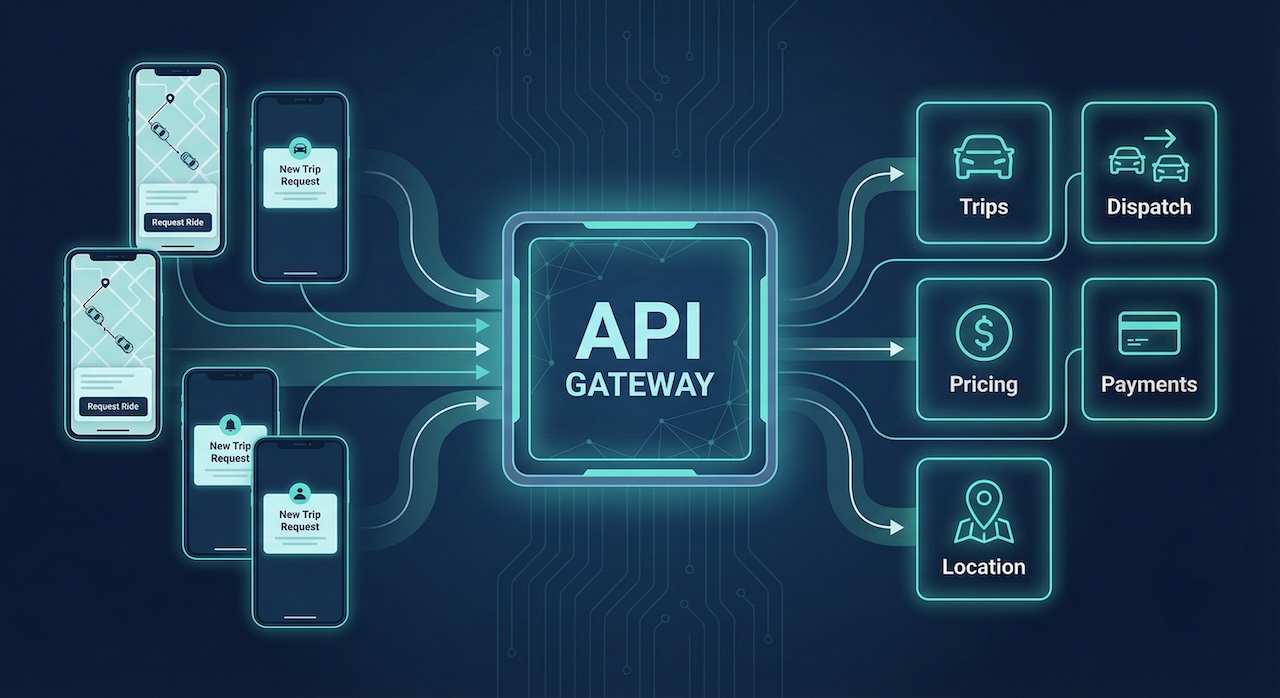
Introduction: why the gateway deserves its own article
In the previous article, one Uber ride flowed through four layers: mobile apps, an API gateway, core services, and data/streaming systems. Every call from Alice (rider) and Bob (driver) touched the gateway first, which handled security, routing, and a lot of hidden complexity.
This article focuses only on the API gateway and edge layer. It explains what it does, how it is structured internally, and how it scales to thousands of APIs and massive traffic in an Uber‑like architecture. You will see text diagrams, flows, and some code-style snippets in simple language.
What the API gateway does in an Uber-like system
Think of the gateway as the front door of the entire ride sharing backend. Clients only know this door; everything behind it can change over time.
Core responsibilities
In an uber system design, the API gateway typically:
- Exposes a single, stable host (e.g., api.company.com) to all mobile and web apps.
- Terminates TLS so services behind can talk in plain HTTP/gRPC inside the data center.
- Checks authentication and authorization (tokens, device IDs, roles).
- Applies rate limits and basic abuse protections.
- Routes each request to the correct backend service (Trip, Dispatch, Pricing, etc.).
- Enriches requests with shared metadata (user ID, locale, experiment flags).
- Collects metrics, structured logs, and traces to monitor the whole system.
Because every request passes through it, a poorly designed gateway becomes a bottleneck; a well-designed gateway makes the whole architecture easier to operate.
High-level architecture of the gateway layer
At a high level, the gateway sits between the outside world and a fleet of internal microservices.
Gateway in the overall system
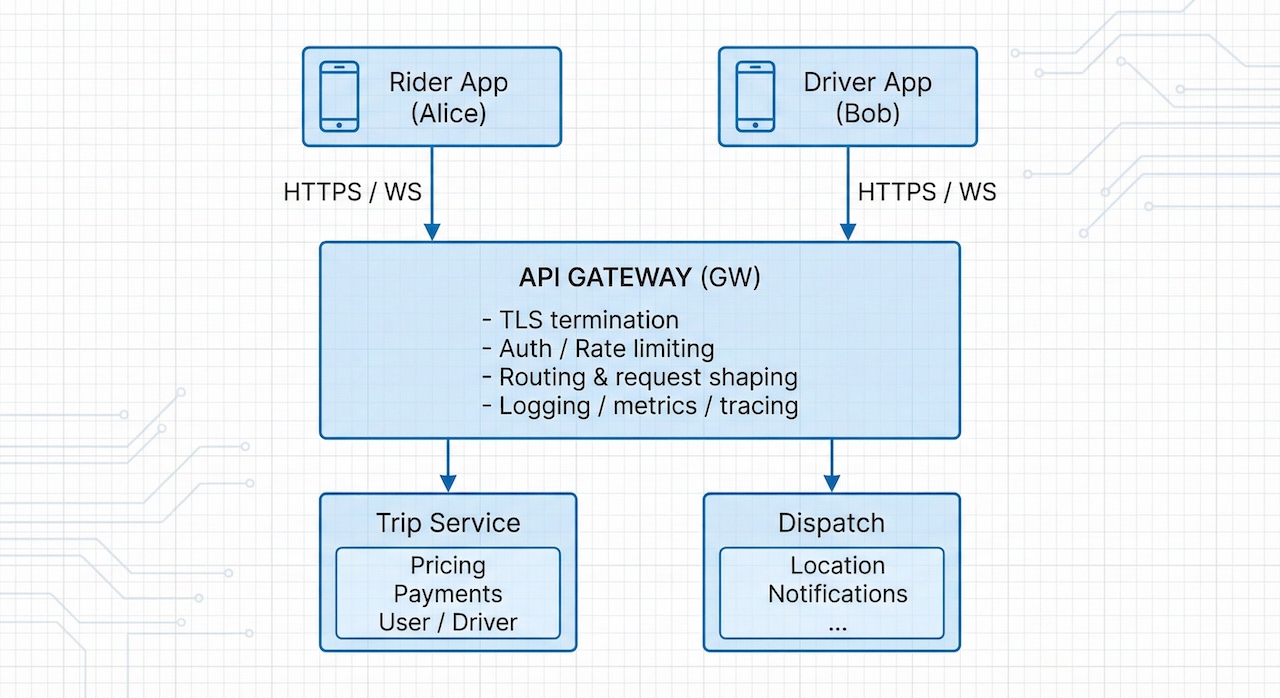
Diagram explained in words
- On the left, the Rider App and Driver App send HTTP(S) requests and open WebSocket or similar streaming connections to the backend.
- All of these connections hit the API Gateway. The gateway handles cross‑cutting work once, instead of each service re‑implementing TLS, auth, and rate limiting.
- The gateway then forwards requests to the right backend services (Trip, Dispatch, etc.) based on the path, method, and internal configuration.
- Services can scale and change independently, while the gateway keeps the client‑facing surface stable.
Inside the gateway: layered request pipeline
Uber’s public descriptions of its API gateway mention a layered design: protocol manager, middleware, endpoint handler, and client. This pattern is useful to copy for your own design.
internal pipeline for one request
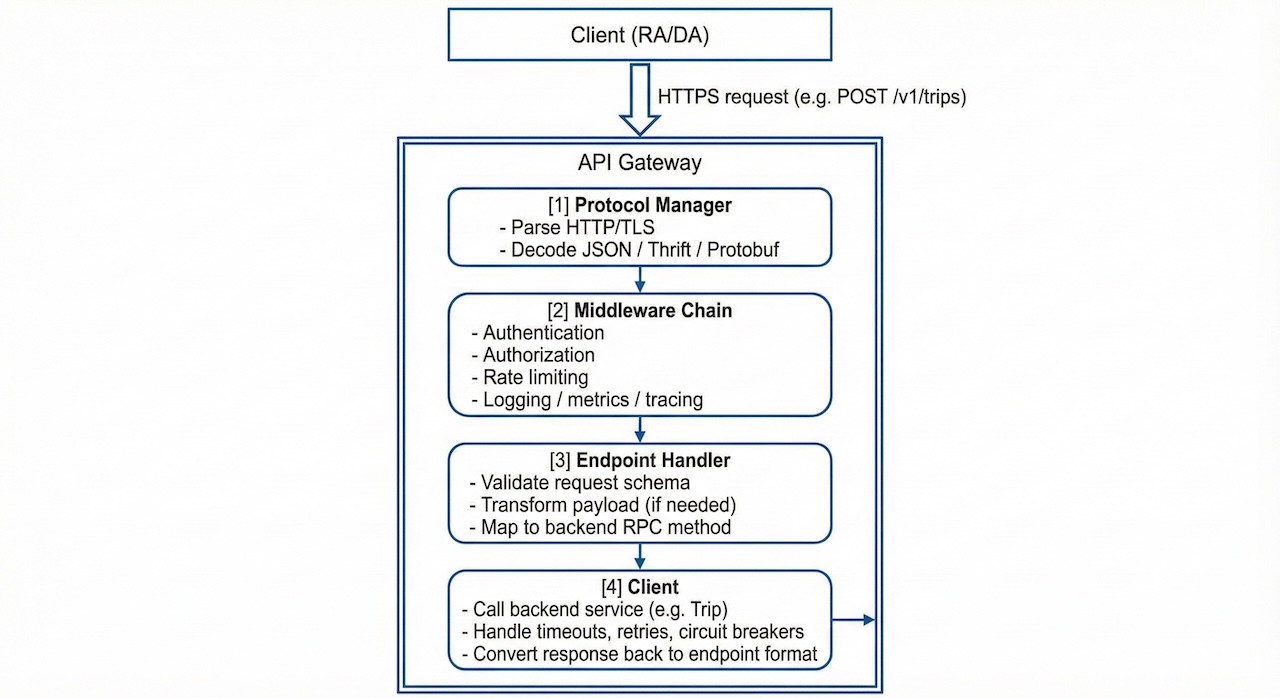
- Protocol Manager (1) is the first layer. It knows how to read and write different wire formats (JSON, Thrift, Protobuf). It deserializes incoming data into an internal request object and later serializes responses back into the format expected by the app.
- Middleware Chain (2) is a configurable list of cross-cutting behaviors. At Uber this includes authentication (tokens, OAuth), authorization checks, per‑user or per‑device rate limiting, and observability (logs, metrics, traces).
- Endpoint Handler (3) handles logic that is specific to one public API endpoint:Validate that the request matches the declared schema.Transform the request into the shape expected by the backend service.Decide which backend method to call (for example Trip.CreateTrip).
- Client (4) is a protocol-aware backend client. It calls the actual microservice (Trip, Pricing, etc.) with proper timeouts, retries, and circuit breaker settings, then maps the result back to the endpoint response.
Because each layer is independent, the gateway can evolve (e.g., adding new middlewares, supporting new protocols) without rewriting everything.
Request flow example: creating a trip
To make the gateway’s role concrete, let’s follow a “create trip” call from Alice’s phone into the backend.
Pseudo API shape
textPOST /v1/trips
Authorization: Bearer <token>
Content-Type: application/json

{
  "rider_id": "alice-123",
  "pickup":  { "lat": 37.6213, "lng": -122.3790 },
  "dropoff": { "lat": 37.7749, "lng": -122.4194 },
  "product": "uberx",
  "payment_method": "card_default"
}
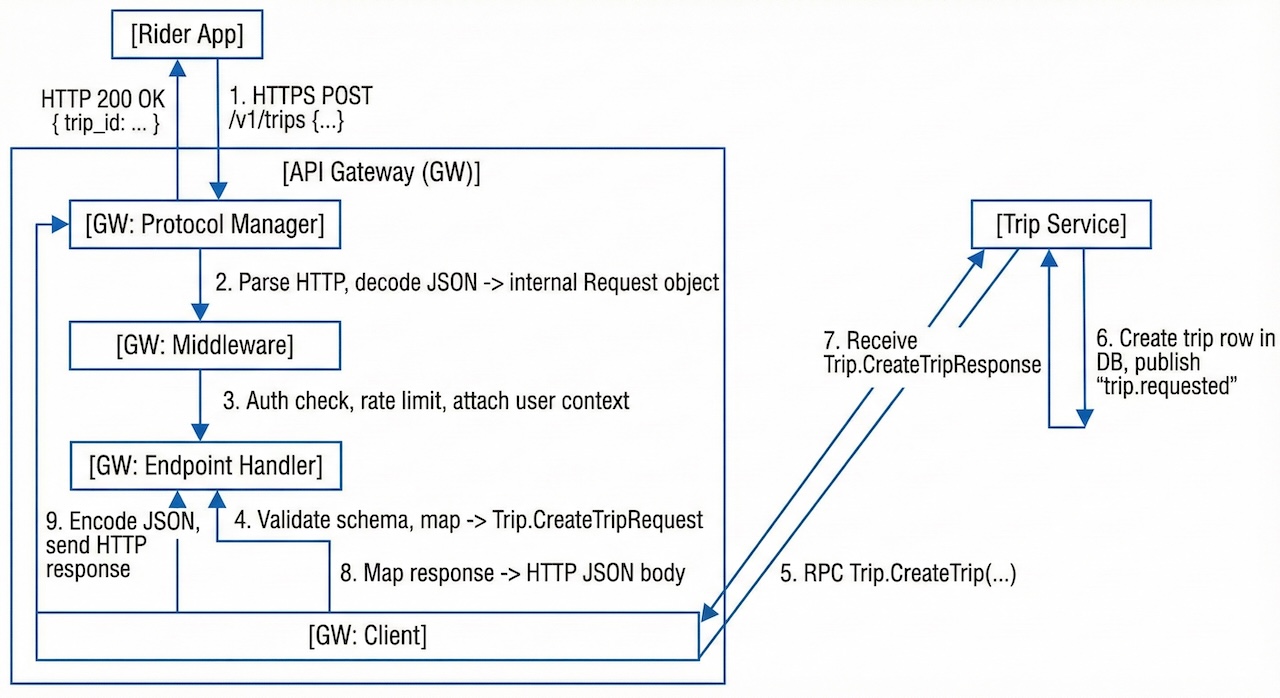
- The Rider App sends a POST request with trip details and an auth token.
- The gateway’s protocol layer terminates TLS, parses the HTTP request, and decodes the JSON payload into an internal representation.
- Middleware validates the token, checks if Alice is allowed to call this endpoint, and enforces rate limits (for example, max X trip creations per minute).
- The endpoint handler makes sure the request body matches the schema (required fields, types). It then builds a CreateTripRequest object expected by the Trip Service.
- The gateway’s client component calls the Trip Service over an internal RPC protocol and waits for a response, using configured timeouts and retries.
- Trip Service writes the trip to the DB and emits lifecycle events; details of that are handled in other articles.7–9. The gateway receives the service response, maps it into an endpoint response JSON, and sends it back to the Rider App.
The Rider App never knows which services were touched or what protocol they use internally; it only sees a clean HTTP+JSON contract.
Example: simple gateway route configuration
In practice, large gateways are usually config-driven: engineers describe endpoints and backends in YAML/IDL, and the system generates code and wiring.
Example configuration (simplified pseudo-YAML)
endpoint:
  name: "CreateTrip"
  path: "/v1/trips"
  method: "POST"
  auth:
    type: "jwt"
    required: true
  rate_limit:
    key: "user_id"
    limit_per_minute: 30
  request:
    schema: "CreateTripRequest.json"
  response:
    schema: "CreateTripResponse.json"
  backend:
    service: "TripService"
    method: "CreateTrip"
    protocol: "grpc"
    timeout_ms: 200
    retries: 2
Config explained in words
- path and method tell the gateway what incoming HTTP calls this rule applies to.
- auth describes the required authentication; here, a JWT must be present and valid.
- rate_limit defines how often this endpoint can be called per user, protecting the backend from abuse.
- request and response schemas define the expected shapes so the gateway can validate and transform messages.
- backend tells the gateway which internal service and method to call, what protocol to use, and what timeouts and retries to apply.
With such config, creating or changing APIs does not require manually editing gateway code for every endpoint.
Scaling the gateway: performance and resilience
Because the gateway sits on the critical path for all traffic, it must scale and fail gracefully.
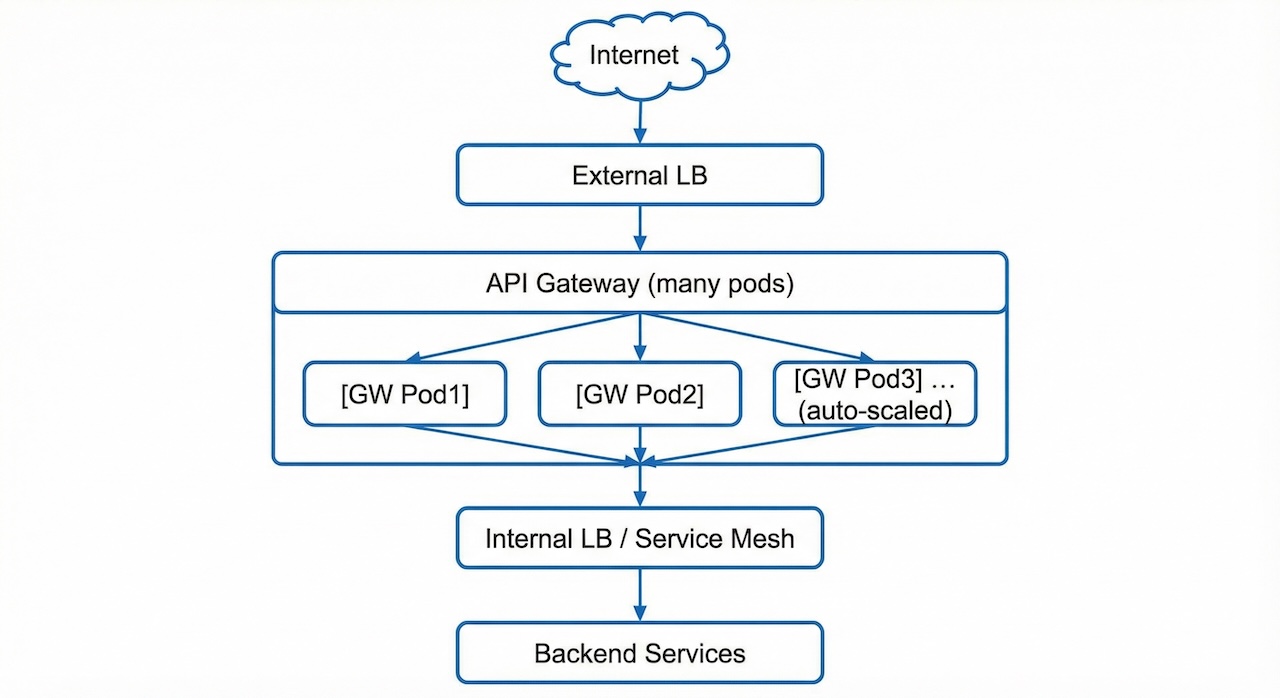
- An external load balancer (from the cloud provider or hardware) spreads incoming traffic across many gateway instances (pods/VMs).
- Each gateway pod runs the full stack (protocol, middleware, handlers, clients) and is stateless, so pods can be added or removed automatically based on load.
- A service mesh or internal load balancer then routes calls from gateway pods to backend services like Trip or Pricing.
- Auto‑scaling rules (CPU, latency, QPS) cause the gateway tier to scale out when demand spikes (e.g., New Year’s Eve).
Resilience patterns
To avoid the gateway becoming a single point of failure, designs often include:
- Multiple instances across availability zones or regions.
- Circuit breakers in clients to avoid endless retries to failing services.
- Graceful degradation (for example, returning cached results or simplified responses when downstream services are slow).
- Strong observability so issues can be detected and fixed quickly.
How the gateway helps real-time features
The gateway also plays a role in real-time experiences like live maps and push notifications, by routing and shaping streaming traffic.
Push from backend to device (simplified)
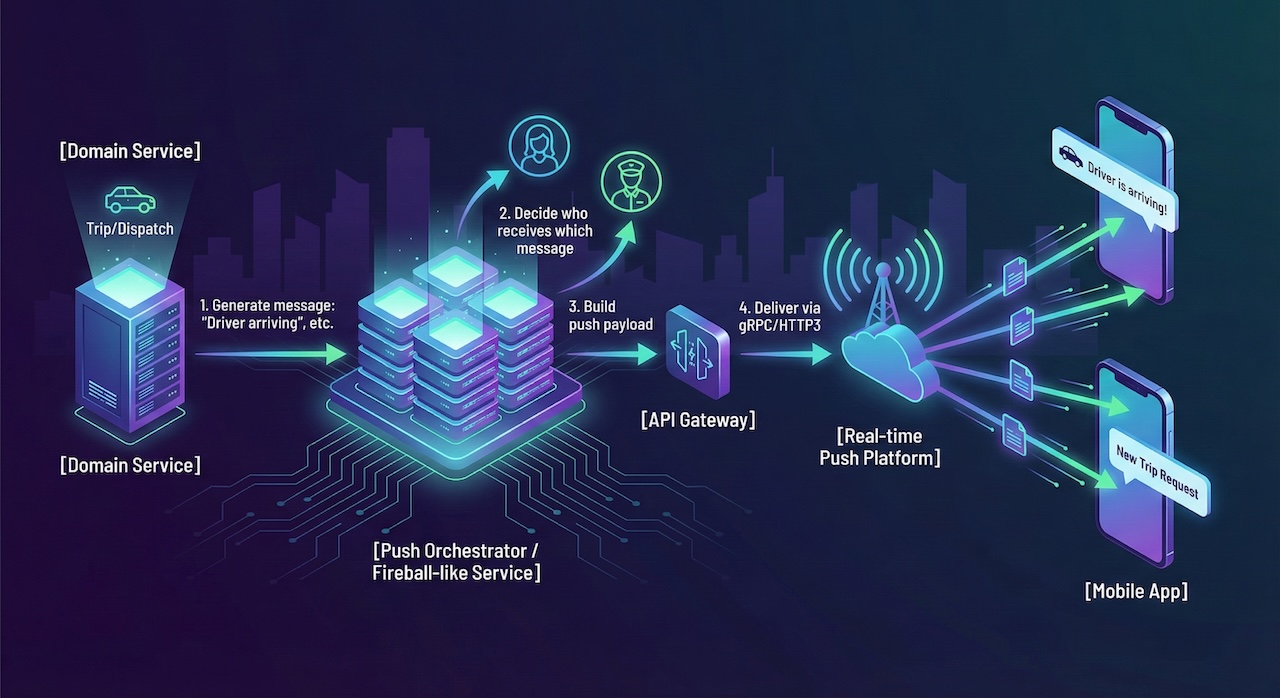
- A domain service (Trip, Dispatch, etc.) emits an event that something important happened, such as “driver assigned”.
- A push orchestrator decides which users should receive which messages and when, so not every small change becomes a push.
- The API Gateway may then be involved in building the payload by querying domain services to fill in details like names, vehicle types, or localized messages.
- A dedicated push platform streams these messages to devices using long-lived connections (gRPC/HTTP3) or traditional push services.
This keeps clients updated in real time while keeping logic centralized and consistent.
Conclusion
This article zoomed into the API gateway and edge layer of an Uber‑like ride sharing architecture, showing how it acts as the single front door for all rider and driver traffic. The layered pipeline—protocol manager, middleware, endpoint handler, and backend client—explains how concerns like TLS, authentication, rate limiting, routing, and retries are separated yet composed for each endpoint. By walking through a concrete “create trip” flow, a sample endpoint configuration, and scaling diagrams, the gateway’s role as both traffic cop and safety net in the uber system design becomes clear. In the next article, the series will move from the edge inward and take a detailed look at the core domain services layer—Trip, Dispatch, Location, Pricing, and Payments—covering their responsibilities, APIs, and how they collaborate to make each ride work end to end.